

Do you really need to apply your sunscreen every 2 hours, even when I'm in the shade or in the city? This recommendation is often cited, but few people actually understand when it applies. In fact, in the majority of cases, sunscreen is effective for two hours, and it is recommended to reapply it four to five times a day. However, this rule is not universal. The frequency of reapplying sunscreen depends in particular on your level of exposure, your activities and your environment. In this article, I explain to you why this rule exists, in which situations it is really necessary, and when a single daily application may be enough.
Why does the 2 hour rule exist?
Health authorities recommend reapplying every two hours to replenish the protective barrier, not just as a precaution. This instruction is based on three well-identified mechanisms that affect sun protection over time.
Degradation of solar filters: Filters degrade in light. In contact with the UV rays that they are supposed to block, these molecules gradually lose their ability to capture electrons excited by the sun. This photodegradation is invisible to the naked eye, but modifies the molecular structure of your cream.
In fact, oxidation begins as soon as you open the tube. Oxygen from the air enters the bottle with each use and slowly attacks the organic filters. You have the illusion of being protected after application, but the chemical barrier weakens over hours of exposure. UV rays pass through this protection which has become less effective without immediately triggering the burn alarm.
The impact of water and perspiration: Even with a water-resistant cream, protection diminishes after immersion. To qualify as water resistant, a cream must maintain its level of protection for 40 minutes of body immersion. The so-called very resistant formulations last 80 minutes.
Therefore, swimming for a few minutes is enough to significantly reduce the effectiveness of the product. Sweating produces the same effect. During physical activities or in high heat, humidity dilutes the protective film. The frequency of reapplication should increase in cases of intense sweating.
Friction and loss of efficiency: The protective film deteriorates mechanically. Each contact with a towel, sand or your clothes removes part of the applied cream. This repeated rubbing creates less covered areas on your skin.
The effectiveness of your protection is limited to two hours, often less when you bathe, sweat or wipe. These factors combined explain why a single morning application is never enough during prolonged outdoor exposure.
In what situations should you really reapply every 2 hours?
The 2 hour rule does not apply uniformly. Some situations require increased vigilance and strict reapplication, while others allow for more flexibility.
Prolonged outdoor exposure: Dermatologists recommend reapplying at least every two hours in case of exposure, even in mixed or overcast weather. This frequency constitutes the minimum base of protection when you spend several hours outside. Between 11 a.m. and 4 p.m., the period when UV intensity reaches its maximum, respecting this interval becomes non-negotiable.
On cloudy days, 30% to 70% of UV rays reach the earth's surface depending on the density of the clouds. You don't feel the heat of the sun on your skin, but the ultraviolet rays work silently. Protection must therefore be renewed with the same regularity as in direct sunlight.
After each swim: No sunscreen is completely waterproof. Water-resistant formulas provide approximately 40-60 minutes of protection in water. The very resistant versions maintain their effectiveness for 80 minutes of immersion. Beyond this period, your skin is left defenseless against ultraviolet rays.
The rule is simple: reapply sunscreen after each swim to be well protected. Wait until your skin is dry, towel dry, then reapply immediately. One wipe equals one new application.
In case of heavy sweating: In the heat, you sweat more, which accelerates the removal of sun protection. Reapplication is then necessary after approximately one hour of intense exposure. Perspiration acts like water on the surface of the skin: the droplets will act as reflectors, which intensifies the action of UV rays.
If you sweat a lot in the heat, apply talcum powder to the skin to absorb moisture before applying cream. This tip slightly prolongs the adhesion of the product.
During sporting activities: Blood circulation accelerates during exercise, the skin heats up and pores dilate, making your skin more sensitive to UV rays. You must therefore reapply the protection every 2 hours during training. After 30 minutes of sport or any activity that made you sweat a lot, put it back on immediately.
Choose a sweat-resistant cream with specific polymers that create a much more adherent protective film.
When is just one application per day enough?
Your daily life doesn't look like a day at the beach. In reality, applying sunscreen every day is not necessary according to Céline Couteau, doctor of pharmacy and specialist in cosmetology. The key lies in observing the UV index and your actual exposure level.
In town and in everyday life: In the city, application in the morning is generally sufficient if you work indoors all day. You cross the street, walk to the metro, do your shopping: these brief and fragmented exposures do not justify systematic reapplication every 2 hours. Sunscreen put on in the morning remains effective for these urban micro-exposures.
In the office or indoors: Provided the UV index is 0 or 1, there is no point in protecting yourself against a threat that does not exist. Your skin doesn't need a constant chemical barrier when you spend eight hours in an air-conditioned office. Even if you work near a window and UVA can penetrate the glass, the intensity is still too low to require reapplication every two hours.
On a cloudy day: The UV index is the only reliable indicator, not how hot you feel. In rainy weather in autumn or winter, when the UV index falls below 2, daily application becomes superfluous. However, monitor the UV forecast rather than the appearance of the sky.
Exceptions to be aware of: However, reapply if you have lunch on a sunny terrace or play an outdoor sport. A midday running outing, a long lunch in the sun, a two-hour walk: in this situation, even in the city, reapplication is essential. The rule remains simple: short, split exposure equals one application, continuous exposure for more than two hours equals reapplication necessary.
The right reflex to facilitate touch-ups
One of the main reasons many people don't reapply their sunscreen is lack of practicality. Carrying a tube of cream, washing your hands before application or having to reapply cream on your face in the middle of the day is not always easy.
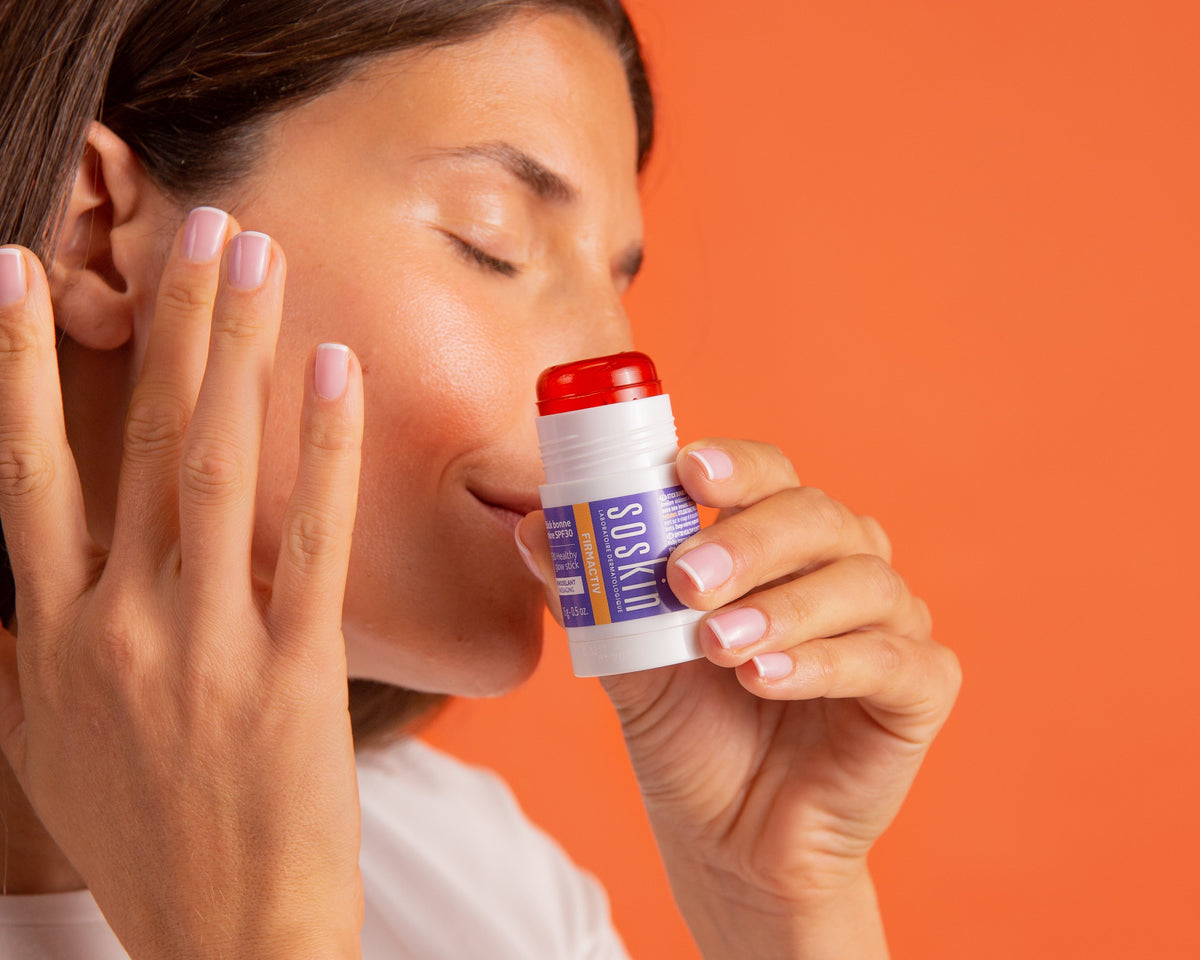
A sun stick SPF50+ can be a great alternative for touch-ups. Its portable format allows you to quickly protect the most exposed areas, such as the face, eye contour, ears, nose, lips, tattoos or even moles, without leaving white marks. Water-resistant and suitable for the whole family from 3 years old, it can be easily carried in a bag or pocket to renew its protection as soon as necessary.
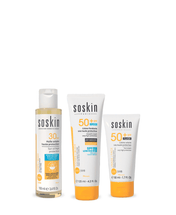
Our recommendation: the Very high protection sun stick SPF50+ SOSKIN combines very high UVA/UVB protection, a non-comedogenic formula, a base of natural origin (excluding filters), antioxidant vitamin E and filter technology SPF LOW-TOX® designed to limit the impact on the marine ecosystem. Its format is particularly practical for touch-ups during the day, where they are most often forgotten.

👉 Discover the SOSKIN SPF50+ Sun Stick : View product
How to properly reapply your sunscreen?
Correctly reapplying your sunscreen requires as much attention as the first application. Technical errors cancel out the benefits of consistency.
The right amount to use: Apply about a teaspoon to the face and neck, and three tablespoons of sunscreen to the body. This quantity corresponds to 2 mg per square centimeter of skin. In practice, most apply only 25-50% of the recommended amount.
Areas often forgotten: The ears, lips, eye area, head and hands are areas that we often forget to protect from the sun. Think similarly about the back of the neck, the décolleté and above the feet.
Reapply over makeup: Pick up sunscreen with a makeup sponge, then apply by patting gently onto the skin. You can also spray the entire face with sunscreen mist in circular motions.
Waiting time before exposure: It takes 5 to 10 minutes before the sunscreen does not stabilize.
Mineral creams vs. chemical creams: On the other hand, mineral screens are immediately active upon application. Chemical filters only become active 20 to 30 minutes after application.
The 2 hour rule is not absolute. It is applied rigorously during prolonged exposure, swimming and sporting activities. In the city or at the office, a single morning application is sufficient in most cases.
Observe your daily UV index and adapt your routine based on your actual exposure. I recommend that you prioritize the quality of the application rather than the multiplication of unnecessary layers. Protection well applied at the right time is better than systematic reapplication indiscriminately.