

Did you know that 46.5% of pregnant women develop pregnancy spots during their pregnancy? These brownish hyperpigmentations, also called pregnancy mask or melasma, generally appear between the fourth and ninth months. Although they are benign, they can persist for up to 6 months after delivery and affect self-confidence.
Fortunately, today we have many solutions to reduce pregnancy spots. In this article, we will explore the causes of this hyperpigmentation, the medical treatments available, effective cosmetic solutions, and in particular the essential preventative actions to protect your skin and avoid their reappearance.
What is pregnancy mask and why does it appear?
Definition and affected areas: Melasma, also called chloasma, results from a disruption in the skin's pigmentation process. Melanin, the pigment responsible for the natural coloring of our epidermis, overproduces in certain places and causes the appearance of brown spots.
These spots appear as symmetrical patches with irregular contours, often located on the forehead, cheeks, upper lip, chin and sides of the nose. In some cases, hyperpigmentation extends to the neck, décolleté, and even the forearms. During pregnancy, we also observe signs on the body: moles and areolas of the breasts darken, while a brown line called “linea nigra” appears on the stomach, from the pubis to the navel.
Hormonal causes: Estrogens and progesterone are the main culprits of this hyperpigmentation. These female hormones stimulate the activity of melanocytes, the melanin-producing cells, in response to UV rays. During pregnancy, our body produces a massive quantity of these hormones, which considerably amplifies the synthesis of melanin.
According to several studies, beta-endorphin also plays a role in this process. In the presence of a hormonal imbalance or increased sensitivity, this production becomes excessive and localized, forming visible spots on our face. Sun exposure acts as a trigger: even a very low level of sunlight is enough to cause these spots to appear.
Types of melasma: epidermal, dermal and mixed: We distinguish three types of melasma depending on the depth of the hyperpigmentation in the skin layers. Epidermal melasma only affects the superficial surface of the epidermis and presents brown spots with well-defined edges. Dermal melasma affects the deeper layer of the skin, the dermis, and is characterized by blue-gray spots. Mixed melasma combines the two previous forms, with gray-brown pigments distributed in the epidermis and dermis. The latter type proves the most difficult to treat due to the depth of the pigments.
Who is most concerned? : According to the American Academy of Dermatology, only 10% of melasma cases affect men. Women with darker skin types are at increased risk of developing this hyperpigmentation. Furthermore, genetic factors play a determining role: if members of our family have had melasma, we are more likely to develop it.
Medical treatments to remove pregnancy spots
When pregnancy spots persist several months after childbirth, we must consult a dermatologist to establish a suitable treatment protocol. Several medical options are available to us depending on the intensity and depth of the hyperpigmentation.
Prescription depigmenting creams: The Kligman trio constitutes the reference drug treatment. This compounded preparation, manufactured in pharmacies on prescription, combines three active ingredients: hydroquinone which destroys melanin cells, hydrocortisone which reduces irritation, and retinoic acid which accelerates cell renewal. These medications are used for a maximum of 8 weeks. However, they remain contraindicated during pregnancy due to the presence of hydroquinone and retinoic acid. The first effects become visible after 3 weeks of treatment.
Chemical peeling: Dermatologists offer peels based on glycolic acid or trichloroacetic acid to exfoliate the superficial layers of the skin. This technique eliminates pigmented cells by slight desquamation. We must wait until breastfeeding is over before starting this treatment. Depending on the extent of the melasma, 3 to 4 sessions spaced 18 days apart may be necessary.
Laser treatment: Fractional, Q-switched or picosecond CO2 lasers destroy the melanocytes responsible for brown spots by emitting targeted radiation. On the other hand, dark skin is less receptive to the laser and is more likely to experience irritation.
Intense pulsed light: Intense pulsed light (IPL) is particularly suitable for light and sensitive skin. It destroys superficial pigment spots by selective micro-burning.
Cryotherapy: Liquid nitrogen cooled to -190°C burns skin cells with cold. Generally, 1 to 2 sessions are enough to erase brown spots.
Cosmetic solutions and natural remedies
Over-the-counter anti-dark spot serums and creams: We can turn to cosmetic solutions available without a prescription to reduce pregnancy spots. Anti-stain serums represent the most concentrated treatments in depigmenting active ingredients. According to a clinical study involving 65 volunteers, 95% of women noted a correction of their spots after 56 days of twice-daily application of a viniferine serum. This patented molecule extracted from vine sap is 62 times more powerful than vitamin C. Anti-spot creams offer a richer texture and are suitable for dry skin. We must apply these products to clean skin, morning and evening, then systematically follow them with a minimum SPF 30 sun protection.
Effective active ingredients: vitamin C, azelaic acid, niacinamide: Vitamin C inhibits the tyrosinase enzyme responsible for melanin production and promotes cell regeneration. However, it quickly oxidizes in contact with air, which reduces its effectiveness. Azelaic acid, a natural derivative of wheat and barley, regulates the activity of melanocytes through a dual enzymatic mechanism. It is particularly suitable for sensitive skin thanks to its anti-inflammatory properties. Niacinamide, or vitamin B3, blocks the transfer of melanosomes from melanocytes to keratinocytes. We can combine these active ingredients together to enhance their effectiveness.
Grandma's remedies: lemon, aloe vera, potato: Lemon juice contains citric acid with natural whitening properties. We apply it directly to the stains for 15 minutes before rinsing. Be careful, we must never expose ourselves to the sun after using it as this could worsen hyperpigmentation. Aloe vera gel MOISTURISES and regenerates the epidermis thanks to its vitamins and collagen. Grated potato is applied morning and evening to the affected areas.
Our anti-dark spot facial routine to even out the complexion
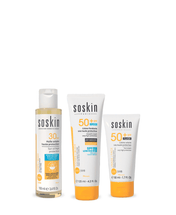
To act effectively on pregnancy spots once breastfeeding is finished, SOSKIN offers a 3-step routine: Radiant cleansing foam (daily gentle exfoliation), the Anti-dark spot radiance serum (reduces melanin production and reduces existing spots, suitable for all types of spots including melasma) and Evening cream (acts both on the surface and in depth to limit the production and transfer of melanin).
👉 Discover the anti-spot facial routine
Prevent recurrence and protect your skin
The importance of daily sun protection: The sun is the primary cause of skin hyperpigmentation. We must apply broad spectrum sun protection with a minimum SPF of 30, ideally 50+, on all exposed areas. This application is necessary daily, summer and winter, even on cloudy days, because UV rays pass through the clouds and affect our skin. We reapply the cream every two hours in case of prolonged exposure, sweating or swimming.
We favor formulas that simultaneously protect against UVA, UVB and high energy visible light (HEVIS). Physical mineral filters act as a shield, while chemical filters absorb radiation instead of our epidermis. We complete this protection by wearing a wide-brimmed hat, sunglasses and covering clothing. We avoid exposure between 10 a.m. and 4 p.m., a period when the sun's rays reach their maximum intensity.
Avoid aggravating factors: Certain photosensitizing cosmetic ingredients amplify the skin's reaction to the sun. We leave retinoids and essential oils out of our routine without proper sun protection. We also ban excessive friction, overly intensive cleansing and repetitive scrubs which stimulate melanin production. We opt for restorative and moisturizing treatments that respect our skin barrier.
Blue light from screens: A study of melanocytes exposed to artificial blue light found significant darkening of melanin pigments. However, the impact of blue light emitted by our screens on hyperpigmentation still requires in-depth research. On the other hand, the blue light of the solar spectrum requires specific protection.
Adapt your contraception if necessary: Hormonal contraceptives rich in estrogen promote the appearance of pregnancy spots. If we notice unsightly hyperpigmentation, we consult a gynecologist to consider a change to a lower dose pill, a copper IUD or an implant. Non-hormonal contraception significantly reduces the risk of melasma.
Pregnancy spots are a reality for almost half of pregnant women. We now have many solutions to alleviate them, from medical treatments to natural cosmetics. Without a doubt, daily sun protection remains our best ally to prevent their appearance and avoid their worsening. We can regain uniform skin by combining patience, appropriate care and rigorous preventive actions.