

Brown spots spare no one and generally appear from the age of 30. Have you tried several products without success? The problem is not always the product itself, but rather the method. These hyperpigmentation marks result from a localized overproduction of melanin, particularly in areas exposed to the sun. Indeed, four main mechanisms cause brown spots on the face: exposure to UV (trigger number 1), post-inflammatory hyperpigmentation, hormonal variations and skin aging. The good news? The first results appear in 4 to 12 weeks with a suitable routine. Discover the effective ingredients, complete routine and mistakes to avoid to remove dark spots from the face.
What is a brown spot and how to recognize it?
A dark spot is an area where your skin produces excess melanin. This pigment accumulation creates a brown color, from light beige to dark brown, depending on the intensity of the disturbance. Visually, these spots present a uniform color with sharp edges and a surface Smooths. They remain stable over time without causing pain, bleeding or itching.
However, there are certain signs that should alert you. A stain becomes suspicious when it changes quickly, becomes very dark or asymmetrical. The appearance of bleeding, crusting or persistent itching requires medical consultation. More than 1.8 million French people are affected by hyperpigmentation.
The 4 main causes of hyperpigmentation
1. Exposure to UV rays Ultraviolet rays directly stimulate your melanocytes, the cells that make melanin. Through repeated exposure, production becomes excessive and poorly distributed. This mechanism causes solar lentigo, the main cause of brown spots on the face and hands.
2. Skin aging With age, your pigment regulation mechanisms become less effective. You lose 10% of your melanocytes every 10 years. Melanin accumulates locally, promoting age spots on exposed areas. This phenomenon is accompanied by melanocyte dysfunction due to repeated attacks by free radicals.
3. Hormonal upheavals Your hormones strongly influence melanocyte activity. Pregnancy, birth control pills or hormonal treatments cause melasma, also called mask of pregnancy. It manifests itself as brownish patches mainly on the forehead, cheeks and upper lip. 10% of cases of melasma affect men.
4. Skin inflammation After an acne breakout, burn or sting, your skin produces excess melanin during healing. Pro-inflammatory cytokines stimulate your melanocytes, creating a hyperpigmentation post-inflammatory. This type of stain particularly affects mixed to dark phototypes.

Why is the face particularly affected?
Your melanocytes are more numerous on the face than on the rest of the body. This concentration explains why brown spots on the face appear more frequently. In addition, your face remains constantly exposed to UV rays, even during daily activities. The skin is also thinner and fragile, making it vulnerable to external aggression.
Active ingredients that really work
Three mechanisms make it possible to treat brown spots on the face: blocking the production of melanin, eliminating pigmented cells and reducing pigment transfer. Each asset acts according to one of these principles.
- Vitamin C for radiance and prevention: Vitamin C inhibits tyrosinase, the enzyme that triggers melanin synthesis. Its antioxidant properties neutralize free radicals generated by UV before they stimulate your melanocytes. It also accelerates cell renewal by boosting collagen production. Dermatologists universally recommend it to fade spots and prevent new pigmentation. Apply your vitamin C serum in the morning, followed by sun protection.
- Niacinamide to block melanin transfer: Niacinamide reduces the transfer of melanosomes by 35 to 68%. Concretely, it prevents pigments from migrating from melanocytes to keratinocytes. You observe an improvement in the clarity of the complexion in a few weeks. Furthermore, it has fewer side effects than hydroquinone. You can use it morning and evening without risk of irritation.
- Tranexamic acid for hormonal spots: It specifically targets melasma. It reduces approximately 49% of the mMASI score at 3 months. Its anti-inflammatory action limits the synthesis of melanin triggered by hormones. Studies show improvement in 69 to 89% of cases. Choose this active ingredient to treat your pregnancy mask.
- AHAs to exfoliate and renew the skin: AHAs, including glycolic acid, physically remove pigmented skin layers. They stimulate cell renewal by dissolving the bonds between dead cells. By penetrating deeply, they regulate the action of melanocytes. Use them in the evening for a deep treatment.
- SPF 50: the non-negotiable asset: SPF 50 remains essential to prevent the appearance of new spots and maintain your results. Sun protection blocks UV rays, the primary factor in aggravating hyperpigmentation. Apply your anti-spot sunscreen every morning, even in winter.
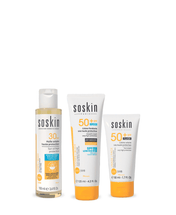
MELADERM anti-spot facial routine from SOSKIN
This trio brings together three complementary treatments to eliminate dead cells, reduce pigment spots and brighten the complexion.
👉 Discover the complete routine
The complete anti-dark spots routine step by step
Apply this complete routine in the order of the steps to maximize your results against facial dark spots.
Step 1: Cleanse your face twice a day with a gel containing AHAs such as lactic or glycolic acid. This cleanse removes dead pigmented cells and prepares your skin to absorb anti-dark spot active ingredients. Massage the product onto your damp face then rinse thoroughly. Avoid abrasive cleansers that disrupt skin balance and worsen hyperpigmentation.
Step 2: Apply your serum after cleansing, directly to the affected areas. For recent sun-related spots, choose a vitamin C serum. Deep, dark spots respond best to hexylresorcinol combined with niacinamide. If you suffer from hormonal melasma, choose tranexamic acid. Drop a few drops and massage gently to facilitate the penetration of the active ingredients.
Step 3: Choose a moisturizer with SPF 30 minimum, ideally SPF 50. Apply it generously to your face and neck about 15 to 30 minutes before any exposure. This step remains essential because UV rays instantly reactivate melanin production. Reapply every two hours if you stay outdoors.
Step 4: Your skin actively renews itself during sleep. Apply a night cream enriched with regenerating active ingredients after your serum. These nighttime treatments combine ingredients that block melanogenesis and nourish the epidermis. Regular use shows significantly reduced spots and a brighter complexion.
Mistakes that sabotage your results
Certain practices undo all your anti-stain efforts, even with the best products. Here are the mistakes that are holding back your results.
- Forgetting daily sun protection: Without SPF, your routine becomes useless. UV rays instantly reactivate melanin production, which darkens existing spots and creates new ones. 60% of stains come from sun exposure. Reapply your protection every two hours in case of prolonged exposure.
- Pierce your pimples and rub the irritations: Popping a pimple introduces bacteria and generates inflammation which stimulates your melanocytes. This post-inflammatory hyperpigmentation persists for 6 to 12 months without appropriate treatment. Resist this temptation to avoid lasting marks on your face.
- Using scrubs that are too aggressive: Abrasive scrubs create lesions on your skin and worsen hyperpigmentation. Limit yourself to one scrub per week for dry skin, two maximum for oily skin. Favor gentle chemical exfoliants over mechanical grains.
- Mixing too many active ingredients at the same time: Combining retinol and AHA becomes too harsh for your skin. This overload causes redness and irritation which triggers more pigmentation. Alternate your active ingredients: one in the morning, another in the evening.
- Expect immediate results: Dark spots on the face require 8 to 12 weeks of regular treatment before seeing visible changes. Stopping after 2 weeks prevents you from achieving your goals.
Dark spots on the face respond to a targeted approach rather than a multitude of products. In reality, the key to success rests on three pillars: scientifically proven active ingredients, non-negotiable daily sun protection and above all, patience. Your first results will appear between 8 and 12 weeks. Regularity turns this routine into a habit, and this habit gradually erases your spots to reveal an unified and luminous complexion.