

Itchy eyes are one of the most common reasons for incorrectly applying sunscreen, avoiding certain areas of the face or forgoing re-applications. However, protecting the face remains essential: UV rays accelerate skin photoaging, promote pigment spots and can also attack the eye itself. UV exposure can cause photokeratitis, a type of “sunburn of the eye”.
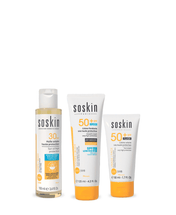
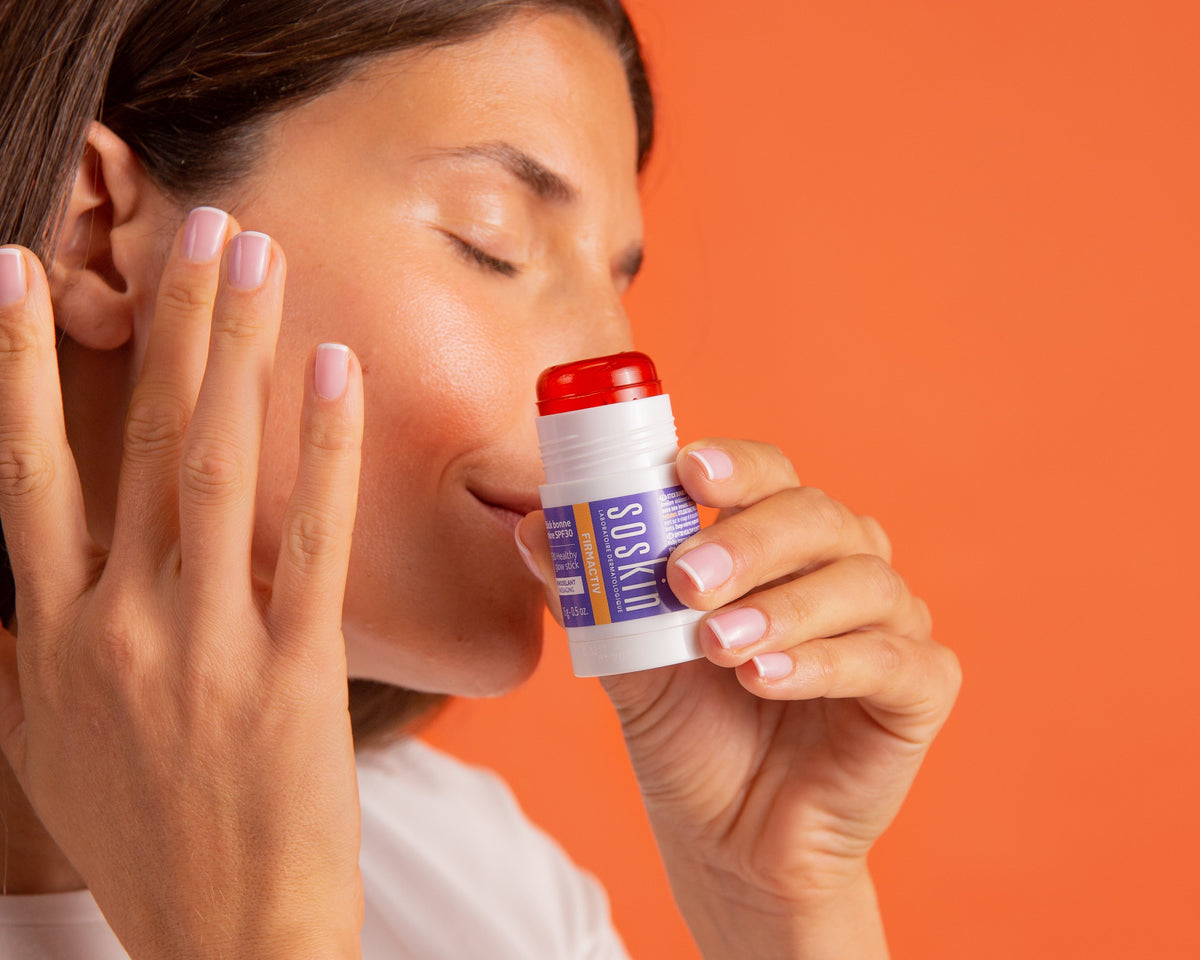
The real problem is therefore not choosing between protecting your skin or preserving your eye comfort. Above all, you have to find the right texture, the right application gesture and the right format according to your sensitivity. Some protections migrate more easily to the eyes with heat, perspiration or friction. Others are better suited to sensitive areas or designed to limit this discomfort. At Soskin, this is played out in particular between the sun stick SPF50+, designed for the face, eye contour and sensitive areas, and the very high protection sun spray SPF50+, formulated to limit eye stinging.
Why can sunscreen sting your eyes?
When sun protection stings, it is not necessarily a “bad” product. Most often, this comes from the migration of the formula towards the eyes. With sweat, heat, oil or friction, product may slide off the forehead, temples, mobile eyelids or upper cheeks. Once in contact with the eye, the discomfort can be immediate: tingling, tearing, burning sensation, persistent discomfort. Cleveland Clinic also points out that certain sunscreens, particularly with organic filters, can cause a burning sensation if they get into the eyes.
It is also necessary to distinguish eye irritation from simple eye discomfort.eyelid eczema or contact dermatitis. The skin of the eyelids is very thin, more vulnerable to irritants and allergens. Cleveland Clinic says cosmetics, makeup and even sunscreen can trigger eyelid dermatitis with redness, burning, stinging or itching. In other words, if the eye area becomes red, dry, burning or itchy, the problem is not always the eye itself: it can also come from the skin which reacts badly to the formula.
The mistakes that most promote itchy eyes
The first mistake is applying sunscreen too close to the lash line. Many people want to protect “to the edge”, but the closer you get to the eye, the more the risk of migration increases. This is even more true with very fluid textures or when the product does not have time to set before an outdoor activity. Some facial formulas remain perfectly suited to the face, but their precautions for use still recommend avoiding the eye area. This is the case of the Very high protection fluid sun cream SPF50+ and High protection invisible fluid SPF50, both of which are intended for the face and neck, with instructions to avoid the eye area.
The second common mistake is choosing the wrong texture for the wrong use. A very light fluid can be excellent on the entire face, but less suitable if you are looking for a product to apply precisely to areas very close to the eyes. Conversely, a stick format generally holds better in place and leaks less. This is precisely the interest of Sun stick SPF50+ Soskin: it protects the face, the eye contour and the areas most sensitive to UV, with a texture designed for homogeneous, invisible application without white marks.
The third mistake, very common, is to reapply with wet, salty, sandy hands or after you have already started to sweat. Well-tolerated sunscreen can become bothersome if you then touch your eyes or apply the product in a hurry. On this point, the form matters a lot: for a quick and targeted touch-up, a stick is often more comfortable than a cream or a fluid. For re-applications on large areas, the spray can be practical, provided you do not spray too close to the eyes. The Very high protection sun spray SPF50+ Soskin is also formulated to limit eye stinging, while recommending, like any sunscreen, to avoid the eye area when applied directly.
What texture should you choose when you have sensitive eyes?
If your eyes sting easily, the first criterion to look at is not only the SPF, but the texture stability and his facial behavior. Creams and fluids are very suitable as a main treatment on the face when they are well tolerated, but they are not necessarily the most reassuring around the eyes. For a person who especially fears product migration, the most secure format is often the one that moves the least once applied. In the Soskin range, the Sun stick SPF50+ responds precisely to this use: it is indicated for the eye contour, sensitive areas, daily use or touch-ups, and its usage results show that it is suitable for sensitive areas and the eye contour in 95% of subjects tested for 28 days.
The spray can also be interesting for people bothered by certain classic sunscreen products, provided it is used intelligently. The Very high protection sun spray SPF50+ has the advantage of being formulated to limit eye stinging, with a light mist and a non-greasy finish. This makes it a good option if you are looking for broad, face and body sun protection that is more comfortable to wear and reapply. On the other hand, it is still preferable not to spray it too close to the eyes and to respect the instructions to avoid the eye contour.
For combination to oily skin who want a light texture every day, the High protection invisible fluid SPF50 can be a good solution on the rest of the face. It protects, mattifies, unifies, and its invisible and non-comedogenic formula is suitable for combination to oily skin, with immediate absorption and without white marks. But again, this is not necessarily the product to favor around the eyes if you are very sensitive.
How to apply facial sun protection without irritating your eyes?

The best reflex is to separate the zones. On the face, apply your main protection to the forehead, cheeks, nose, chin and neck, leaving a few millimeters of margin from the eyelashes and mucous membrane. For really sensitive areas, close to the eyes, choose a more precise format, more stable and less likely to migrate, such as a stick adapted to this area. This logic allows you to maintain good solar coverage while limiting tingling. Soskin's application recommendations are in this direction: the stick is intended for the eye area, while other facial or spray sunscreens rather require avoiding this area when applied directly.
The other key point is to wait a few minutes before going out, sweating or putting on makeup. The more you apply just before an activity, the more likely the product will move. If you know you'll be walking, playing sports, or spending a long time in direct sunlight, protection that holds well and is easy to reapply becomes even more important. For this, the most logical duo is often: a facial sun protection all over the face, then a solar stick on sensitive areas and for touch-ups. The Soskin stick has also been designed in this nomadic spirit, with a practical format for daily use or for touch-ups.
Finally, if your eyes really burn with each sun, you should also consider a particular sensitivity. The American Academy of Dermatology advises people whose skin “stings or burns” with sunscreen to choose a formula with zinc oxide and titanium dioxide, and avoid sun protection with perfume. For sensitive skin, the AAD also recommends looking for sensitive skin formulas and avoiding certain ingredients like oxybenzone.
Which protection should you choose based on your actual use?
For use daily, in the city, with the need for touch-ups and targeted protection around the eyes, the right choice is generally the format that is best controlled. In the Soskin range, the SPF50+ Sun Stick is the most consistent for this use: protection of the face, eye contour and sensitive areas, antioxidant formula, invisible finish, water resistance and easy-to-go format.
For a longer day, with wider exposure of the face and body, the Very high protection sun spray SPF50+ is more practical. It offers very high protection, a non-greasy finish, a light mist and a formula designed to limit eye stinging. This is a good solution when you want a sunscreen that is easy to use, comfortable and compatible with frequent reapplications, as long as you keep the right gestures around the eyes.
For people who especially want a light and mattifying texture on the face, especially on combination to oily skin, the High Protection Invisible Fluid SPF50 remains an interesting option. And for more enveloping face protection whenprolonged exposures, the very high protection fluid sun cream SPF50+ remains suitable. But in both cases, it is better to keep the following logic: these products cover the face very well, while the immediate eye area often deserves a more specific format if you are prone to tingling.
In summary, if your sunscreen stings your eyes, the problem does not only come from your sensitivity: it often comes from a bad pairing of texture + application area. The right facial sunscreen is the one that you tolerate well, that you apply correctly, and that you are willing to reapply. When the eyes are sensitive, it is better to think in two stages: a main protection for the face, and a more targeted protection, more stable or formulated to limit the tingling around delicate areas.