

Seeing pimples always appear in the same place, particularly on the chin, is a common situation in adulthood. In many women, this area becomes sensitive at certain periods of the cycle and imperfections return almost predictably. This does not mean, however, that everything is purely hormonal or that a simple cosmetic change is enough to explain everything. In reality, pimples on the chin in adults often appear in an area where hormonal fluctuations play an important role, while skin weakened by an overly aggressive routine can maintain inflammation and complicate improvement.
Why do pimples often appear on the chin in adulthood?
Adult acne does not always appear like adolescent acne. In adult women, it commonly affects the lower face, particularly the chin, jaw and sometimes the neck. This location is well known in dermatology, with a more inflammatory predominance and a particular sensitivity to hormonal variations. The affected adult skin is also often more reactive, which explains why certain very active treatments, although deemed effective, are poorly tolerated and give the impression that the skin can no longer support anything.
The chin is not a trivial area. It often concentrates pimples that are redder, more painful and more persistent than on other parts of the face. Many people also observe a regular reappearance of lesions in the same place, with imperfections which take time to disappear and leave marks more easily. This profile often evokes adult acne with a hormonal component, but it can also be aggravated by stress, perspiration, handling the area, or by an overly stripping routine which weakens the skin barrier.
What signs suggest a hormonal origin?

When the spots on the chin follow a fairly regular rhythm, the hormonal track becomes particularly credible. This is often the case when breakouts intensify just before or at the start of your period. In some women, blemishes also appear after stopping contraception, during perimenopause or other periods of hormonal variation. The American Academy of Dermatology also points out that hormonal fluctuations around periods, during pregnancy, perimenopause or menopause are common causes of adult acne.
The appearance of the buttons also gives clues. Chin acne with a hormonal component often manifests itself as deeper inflammatory lesions, sometimes sensitive to the touch, which remain under the skin for several days. They don't always look like a multitude of small superficial pimples. These may be more stubborn lesions, located on the lower face, with phases of calm then relapse. This cyclical character and this low location are very evocative elements.
We also need to look at the general context. When chin pimples are accompanied by other signs such as irregular, very painful periods, more marked hair loss, unusual weight gain or excess hair, medical advice is useful. The French Society of Dermatology specifies that additional examinations are not systematic in acne, except in the presence of associated signs such as hyperandrogenism or cycle disorders. In this case, the doctor may decide to take the assessment further.
That said, talking about hormonal acne does not mean that there are no solutions other than medical. Above all, this means that you have to stop feeling guilty. If spots on the chin keep coming back despite good care, the problem does not necessarily come from a lack of hygiene or bad will. The skin sometimes reacts to an internal situation, and the good strategy then consists of supporting it gently while consulting if the situation becomes persistent or painful.
To read: know how to eliminate pimples on the face in adults.
Can an unsuitable routine make chin spots worse?
Yes, but it is important to word it well. An unsuitable routine is not always the cause, especially when the hormonal component is strong. On the other hand, it can make the situation worse. This is often the case when the skin is cleansed too often, stripped with aggressive products, or exposed to too many active ingredients at the same time. The American Academy of Dermatology points out that using a new anti-acne product every few days can irritate the skin and cause new breakouts, while a treatment needs several weeks to be properly evaluated.
The chin is an area that quickly suffers when the skin barrier is weakened. Skin that feels tight, hot, peels or becomes uncomfortable is not necessarily “purging”. She may just be irritated. In this case, general inflammation increases, the skin defends itself poorly and imperfections appear more numerous or more visible. In adult women, this tolerance difficulty is all the more common as acne on the lower face often occurs on skin that is already sensitive and reactive.
Certain daily habits also play a role. Often touching your chin, resting your face in your hand, letting perspiration dry on the skin, using textures that are too rich or, on the contrary, trying at all costs to dry out the spots can make the problem last. Acne care recommendations go in the opposite direction: gentle cleansing, non-comedogenic products, no overwashing and a regular routine rather than a series of tests.
What can you actually do to soothe pimples on your chin?
The first step is to simplify. When the chin is the site of repeated breakouts, you must resist the urge to accumulate products. A short, consistent routine is often more helpful than a busy routine. A gentle cleanser morning and evening, light but comfortable hydration, then appropriate sun protection during the day provide a solid foundation. The NHS recommends a simple, regular and non-aggressive approach, with treatments that do not clog pores and non-comedogenic sun protection.
Then you have to give the skin time. Many adults change their serum, cream or cleanser as soon as a new pimple appears. However, this instability often fuels irritation. According to the American Academy of Dermatology, it usually takes at least four to six weeks to start seeing if a treatment improves the skin, and sometimes two to three months to see real improvement. Wanting to speed up the process by multiplying tests often ends up confusing the results.
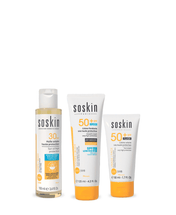
If the skin on the chin is sensitive, reactive and prone to imperfections, it is better to favor a calming routine rather than a logic of stripping. With this in mind, directing the skin towards a Soskin routine designed for sensitive skin can be consistent. The idea is not to rely entirely on powerful active ingredients, but to restore a more stable framework with gentle cleansing, well-tolerated moisturizing care and light daily protection. When the skin is less damaged, it often supports the rest of the treatment better and spots become easier to control over time.
It is also essential not to manipulate the lesions. Popping a pimple on the chin sometimes gives the illusion of immediate improvement, but actually increases the risk of prolonged inflammation, marks and scarring. If the lesions are deep, painful or always reappear in the same place, it is better to avoid local relentlessness and observe the rhythm of the flare-ups. It is often these details which then help to better guide treatment with a professional.
When should you consult a dermatologist?
A consultation becomes relevant when pimples on the chin are painful, frequent, inflammatory, or leave marks. This is also the case if flare-ups persist despite a simple and well-followed routine for several weeks. Dermatologists remind us that it is not necessary to wait for acne to “go away on its own”, especially when it affects morale, self-image or quality of life.
It is also necessary to consult if chin imperfections are accompanied by signs that suggest a more marked hormonal cause, such as irregular periods, excess hair growth or other associated symptoms. Finally, when pimples around the mouth burn, itch, or don't look like typical acne, it's helpful to have it checked to make sure it's not another skin condition, like perioral dermatitis or folliculitis. A good diagnosis avoids treating the problem next to it.
In summary, pimples on the chin in adults often have a hormonal component, especially when they are cyclical, inflammatory and located on the lower face. Routine is not necessarily the initial cause, but it can clearly make the situation worse if it is too aggressive or unstable. The best approach is therefore to observe the rhythm of the outbreaks, calm the skin with a gentle routine, and consult as soon as the lesions become deep, repeated or associated with other signs.